June 8 2026

People of ICEBERG: Markus Schartau & Vanessa Lampe from GEOMAR

Throughout the ICEBERG project, we will introduce the people working on the project. In this personal introduction, Markus Schartau and Vanessa Lampe from GEOMAR introduce themselves and share what inspires them about ICEBERG.

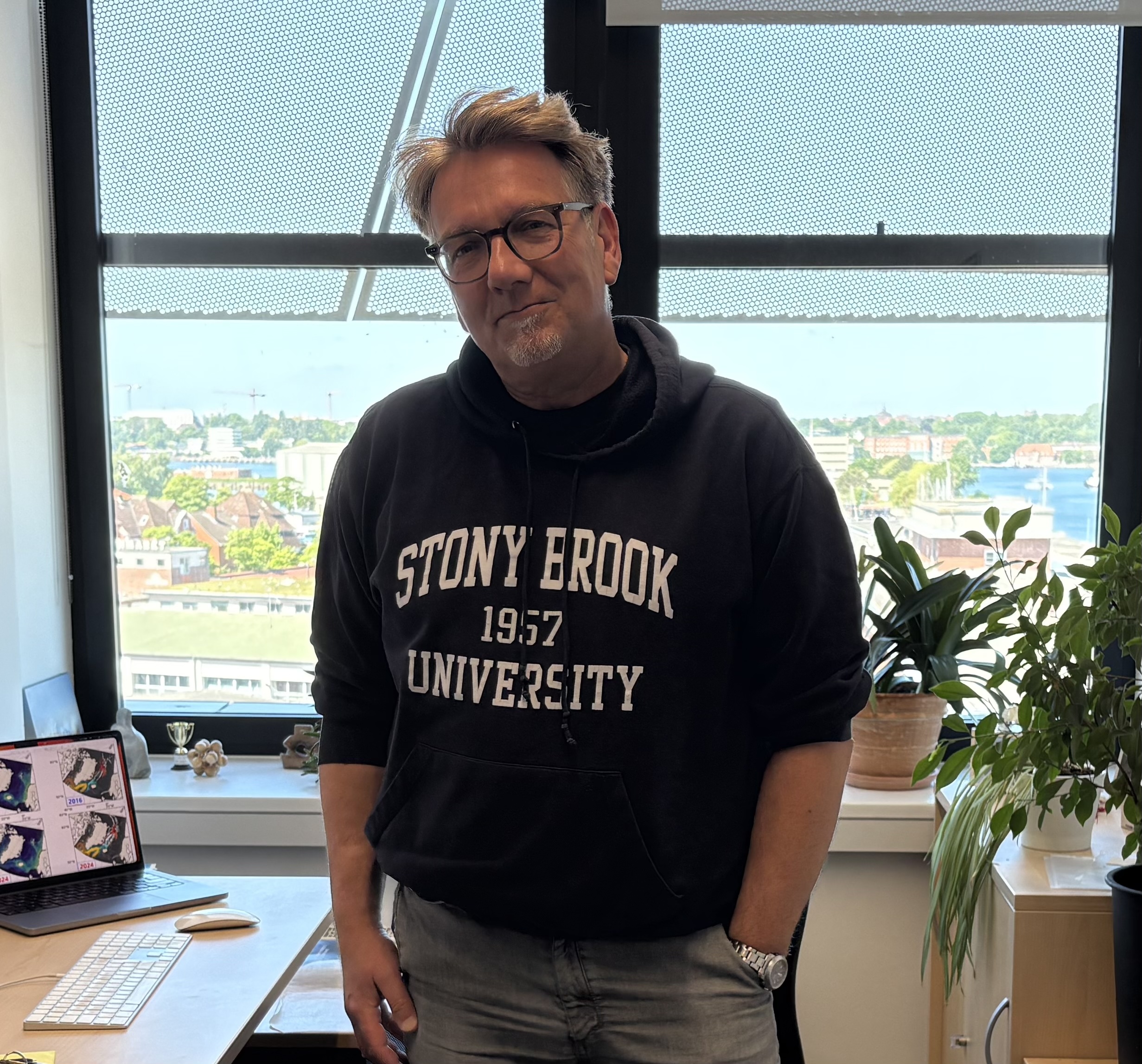
A man with light brown hair and glasses standing and smiling in an office setting. He is wearing a dark hoodie with the text "Stony brook 1957 university" on it.

Photo credit: Vanessa Lampe

Moin!

I am Markus Schartau and I work as principal investigator in Work Package 1 (WP1) in ICEBERG. As a student, I moved from Lake Constance in the southernmost part of Germany (good food!) to Kiel in the north. In Kiel, I was able to study physical- and biological oceanography, two marine science disciplines that became part of my life ever since.

After graduating, I followed up with research stays at other marine research institutes in the US and Germany. Eventually, I returned to Kiel in 2013, starting as scientist at the GEOMAR Helmholtz Centre of Ocean Research Kiel.

Although my research interests are wide-ranging, I have always used computer models and combined them with observations to gain a better understanding of the physical, biological, and chemical processes in the ocean. It is always fascinating to explore how the various regions of the Arctic are connected through ocean currents, despite the vast distances between them.

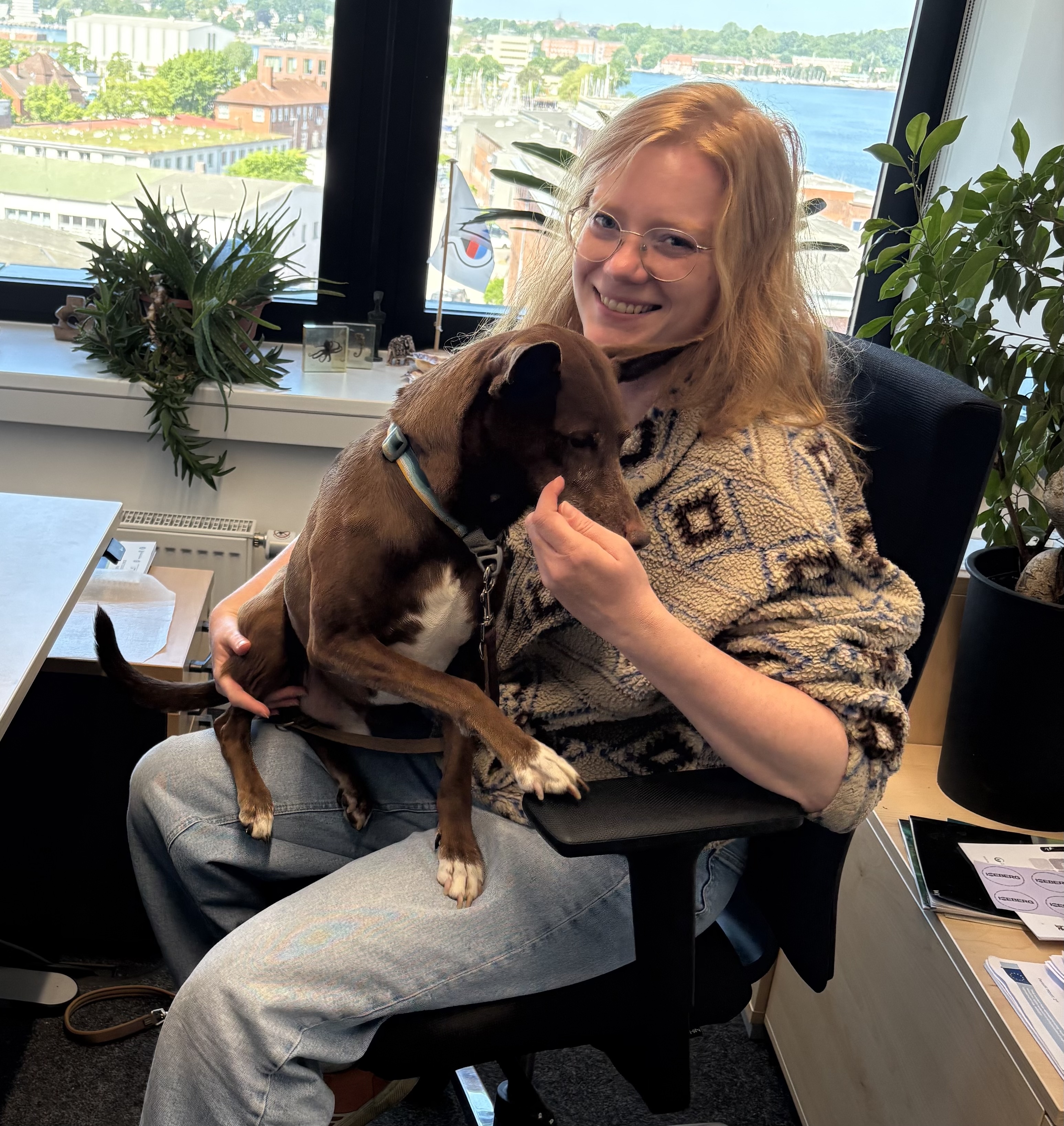
This also means that my “fieldwork” usually consists of office work, in which my desk-sized field takes up relatively little space compared to the sea. I sometimes get a visit at my desk from Piet, a dog that belongs to Vanessa.

“It is always fascinating to explore how the various regions of the Arctic are connected through ocean currents, despite the vast distances between them.”
A woman with light long hair and glasses, sitting in an office chair and smiling. She has a small brown dog in her lap.

Photo credit: Markus Schartau

I am Vanessa Lampe, a post-doctoral researcher who is particularly keen on working with model simulations of plankton dynamics. My background is in biological oceanography, and for my PhD thesis, in the Biogeochemical Modelling Group at GEOMAR, I worked on model simulations and remote sensing data in the Arctic Ocean. Since then, computer applications have played a central role in my research, but I am also interested in fieldwork. As a certified research diver, I have taken part in several field studies.

After finishing my PhD in 2024, I began working for the ICEBERG project’s WP1 until December 2025. My research in ICEBERG focused on combining Arctic Ship Traffic Data with model simulations that track the movement of seawater into and out of those case study sites under investigation. To this end, I have carried out several thousand model runs.

Our aim has been to gain a better understanding of how the discharge of grey, black, and scrubber water from ships affects the plankton ecosystem in the Arctic. I am delighted that I have been able to, as part of the ICEBERG project, broaden my skills and gain insights from various environmental, social and economic perspectives on issues that are important to the Arctic regions.

Last but not least, it should not go unmentioned that I love dogs. My dog, Piet, is always by my side as I work, unless he is visiting Markus in his office.

“I am delighted that I have been able to, as part of ICEBERG, broaden my skills and gain insights from various perspectives on issues that are important to the Arctic regions.”

In our research unit, we develop and apply models to investigate issues that cannot be resolved simply by collecting data, such as the relationships between plankton growth and the flux of elements like carbon, nitrogen and phosphorus in the ocean.

We are happy to be part of the ICEBERG research consortium and are eager to gain new insights into how shipping affects the biogeochemistry of the marine environment. Such biogeochemical changes are likely to impact the conditions of valuable coastal areas that are important to locals. New knowledge in this regard is important to us.

As a part of her work in ICEBERG, Vanessa has already conducted 8400 model runs, and Markus will perform statistical analyses of these results. Additional model runs are planned to also assess the potential impact of scrubber water on plankton. For these model runs, we will be integrating the experimental results from the research conducted by Dennis Booge and Christa Marandino in WP1.

We are pleased that, with the help of our computer simulations, we are now better able to assess the extent to which maritime traffic is affecting the vital marine environment of the surrounding communities.

Stay tuned for more

Stay tuned on ICEBERG by subscribing to our newsletter and following us on social media:

LinkedIn
Facebook
Instagram

Subscribe to our newsletter and stay updated on the progress of the project.

Subscribe

Project Scientific Coordinator

Prof. Thora Herrmann
University of Oulu
thora.herrmann@oulu.fi

Co-coordinator, Project Manager

Dr Élise Lépy
University of Oulu
elise.lepy@oulu.fi

Communications

Marika Ahonen
Kaskas
marika.ahonen@kaskas.fi

Innovative Community Engagement for Building Effective Resilience and Arctic Ocean Pollution-control Governance in the Context of Climate Change

ICEBERG has received funding from the European Union's Horizon Europe Research and innovation funding programme under grant agreement No 101135130

Privacy Policy