February 17 2026

People of Iceberg—Benjamin Pontiller from GEOMAR

Throughout the ICEBERG project, we will introduce the people working on the project. In this personal introduction, Benjamin Pontiller from GEOMAR introduces himself and shares what inspires him about ICEBERG.

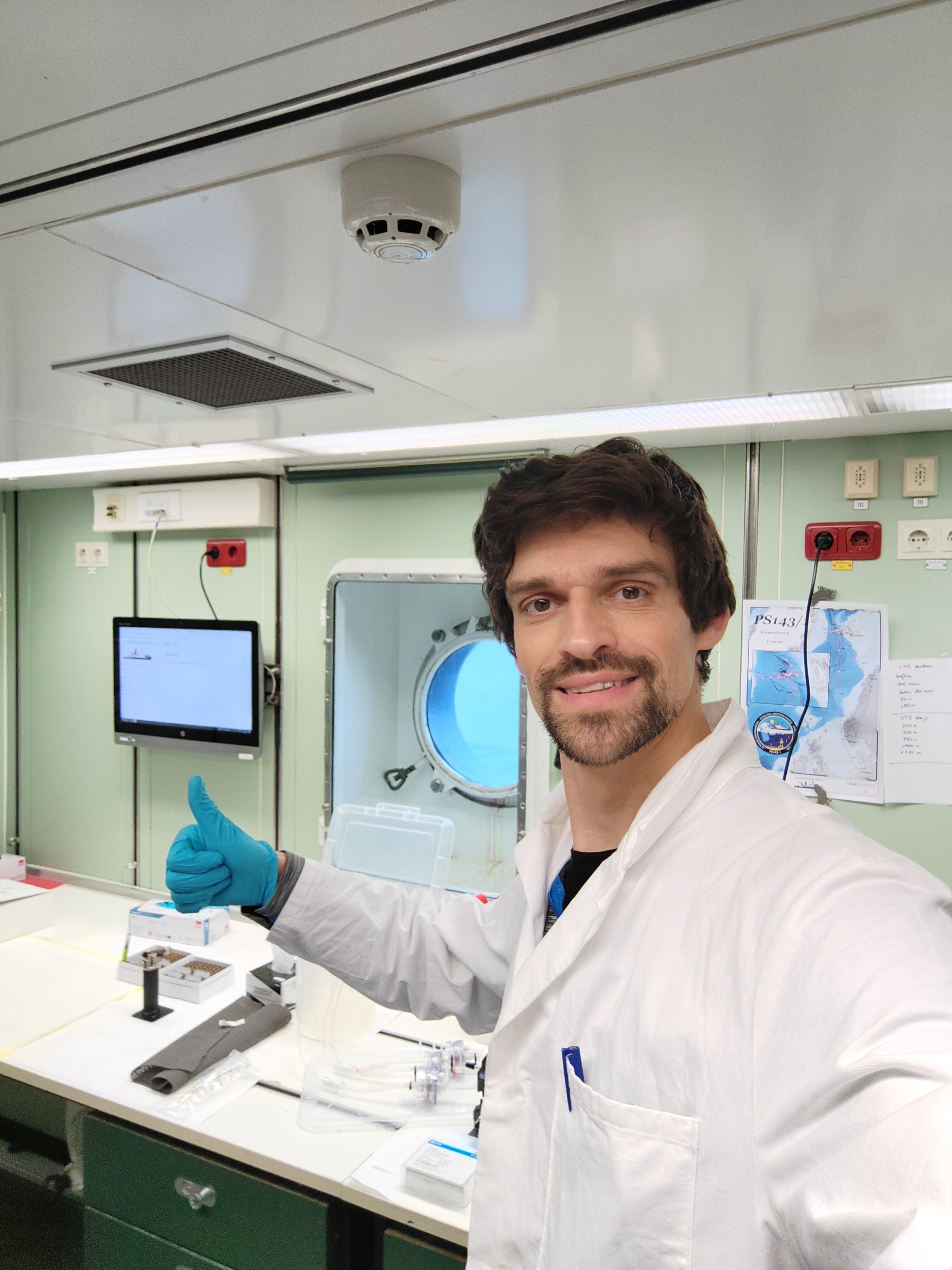
Picture of a dark featured man smiling. He is wearing a lab coat and gloves, in a lab setting.

Photo credit: Benjamin Pontiller

Hi! I’m Benjamin Pontiller, a microbial ecologist and Postdoctoral Researcher in the Biological Oceanography unit at the GEOMAR Helmholtz Centre for Ocean Research Kiel. My research combines fieldwork, experimental approaches, and cutting-edge molecular methods to better understand how microbial community composition and function respond to environmental change.

Within the ICEBERG project, I work in WP1, where my research focuses on how plastic pollution and microplastics in Arctic waters provide surfaces for microbial life and how this may influence the presence and distribution of antimicrobial resistance genes. As part of the project, I collect microplastic and seawater samples and conduct incubation experiments during expeditions aboard the icebreaker Polarstern. Using advanced genomic and molecular tools, I investigate the genetic potential of microbes living on plastic surfaces.

In collaboration with my colleagues in WP1, we have also carried out long-term deployments of different plastic types attached to underwater anchors in Kongsfjorden and Krossfjorden. Together, these efforts help determine whether plastics in the ocean act as hotspots or transport vectors for microbes carrying resistance traits – knowledge that is crucial for assessing biological risks to Arctic ecosystems and local communities.

"I am convinced that our collective efforts within ICEBERG will make a meaningful difference in terms of how pollution is addressed, especially in remote regions like the Arctic. "

From a scientific perspective, being part of ICEBERG allows me to combine my interest in marine microbial ecology with pressing environmental challenges in one of the planet’s most remote and rapidly changing regions.

On a personal level, I feel a strong sense of purpose and inspiration working within a truly transdisciplinary team. We are united by the goal of assessing and understanding pollution impacts and developing solutions to mitigate them.

What I find particularly inspiring about ICEBERG is that the knowledge we generate on the effects of pollutants on ecosystems, wildlife, and human health directly feeds into policy recommendations aimed at reducing risks to the Arctic environment and communities. Equally important, local communities and Indigenous rights holders are at the heart of the project. I am convinced that our collective efforts within ICEBERG will make a meaningful difference in terms of how pollution is addressed, especially in remote regions like the Arctic. Being part of this endeavour fills me with deep gratitude.

Stay tuned for more

To stay tuned on ICEBERG, follow us on social media and subscribe to our newsletter to get the updates to your own email.

Get to know more ICEBERG people:

Find ICEBERG on:

Subscribe to our newsletter and stay updated on the progress of the project.

Subscribe

Project Scientific Coordinator

Prof. Thora Herrmann
University of Oulu
thora.herrmann@oulu.fi

Co-coordinator, Project Manager

Dr Élise Lépy
University of Oulu
elise.lepy@oulu.fi

Communications

Marika Ahonen
Kaskas
marika.ahonen@kaskas.fi

Innovative Community Engagement for Building Effective Resilience and Arctic Ocean Pollution-control Governance in the Context of Climate Change

ICEBERG has received funding from the European Union's Horizon Europe Research and innovation funding programme under grant agreement No 101135130

Privacy Policy