December 19 2025

Following Microplastics Through Arctic Zooplankton: Reflections from Two Scientific Meetings

Even in the Arctic’s seemingly untouched waters, tiny, hard-to-detect particles are building up in the marine food web, with consequences for Arctic ecosystems. In the autumn of 2025, Alessandro Nicolai shared his research on microplastics in Arctic zooplankton at two scientific gatherings in Norway, including the Svalbard Science Conference and meeting at the Fram Centre in Tromsø. In this post, the ICEBERG researcher from the Italian Institute of Polar Sciences reflects on the events and the scientific exchange they enabled.
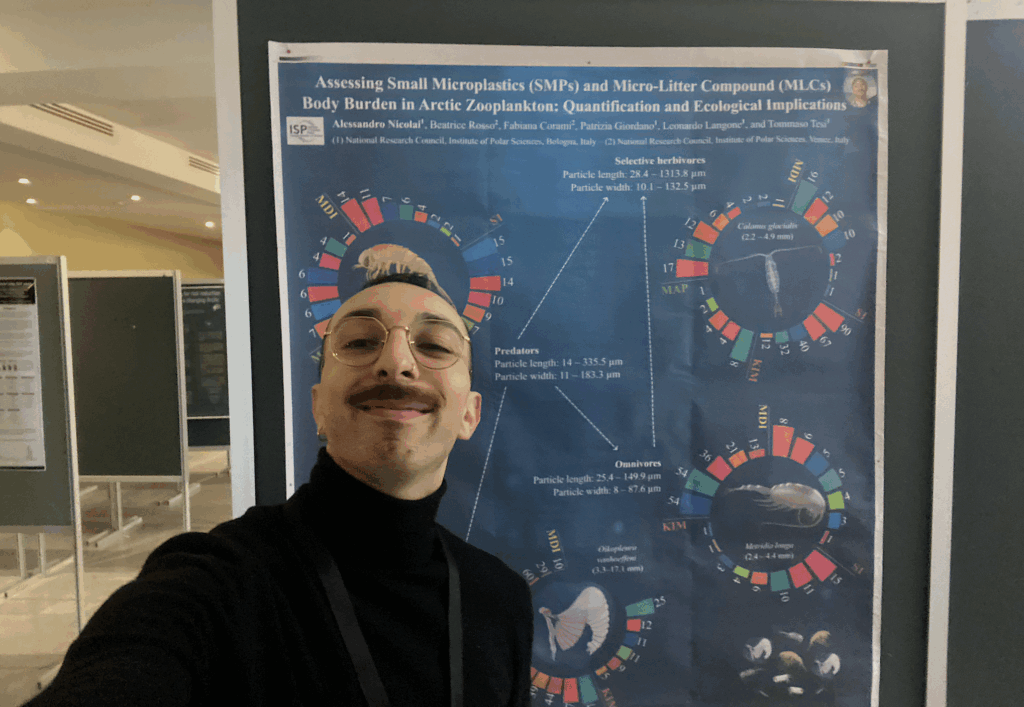
Alessandro Nicolai stands in front of his scientific poster on microplastics in Arctic zooplankton at a conference venue.
Alessandro Nicolai presented his poster on microplastics in Arctic Zooplankton at the Svalbard Science Conference 2025.

The Svalbard Science Conference 2025, held at the Quality Expo Hotel in Fornebu (Oslo), between 28–29 October 2025 provided an excellent opportunity to present and discuss the results of my research. Focusing on microplastics and micro-litter components in Arctic zooplankton around Svalbard, the conference also fostered scientific exchange on one of the most pressing topics in marine science and ecotoxicology.

During the event, I presented a poster entitled “Assessing small microplastics (SMPs) and Micro-Litter Compound (MLCs) Body Burden in Arctic Zooplankton: Quantification and Ecological Implications”. The work focused on pollutants that are presumed to be widely distributed in the environment, but remain poorly detected due to their extremely small sizes (typically <100 µm).

The poster illustrated trophic interactions and accumulation patterns of multiple toxic compounds in coastal and pelagic ecosystems of Svalbard, combining a quantitative assessment of particle abundances with a qualitative characterization of their polymer composition, size and morphology.

"Zooplankton emerged as a critical entry point for pollutants into the local food-web chain."

Understanding Accumulation in Arctic Food Webs

These topics were further explored and discussed during an online presentation at The Atlantic-Arctic Distributed Biological Observatory (A-DBO) meeting, held on 10–11 December 2025 and hosted at the Fram Centre in Tromsø (Norway). This presentation provided deeper insights into the mechanisms of accumulation in organisms, as well as the potential sources and sinks of microplastics and micro-litter components in the Arctic environment.

Our analyses suggested that contributions from both long-range transport processes – including atmospheric pathways and ocean currents – and local point sources, mainly linked to human activities such as fisheries, maritime traffic, and scientific research operations.

Overall, the study revealed a clear relationship between pollutant body burden, spatial variability and feeding strategies, with distinct, species-specific accumulation patterns across four trophic levels (.e., filter-feeders, selective herbivores, omnivores and carnivores).

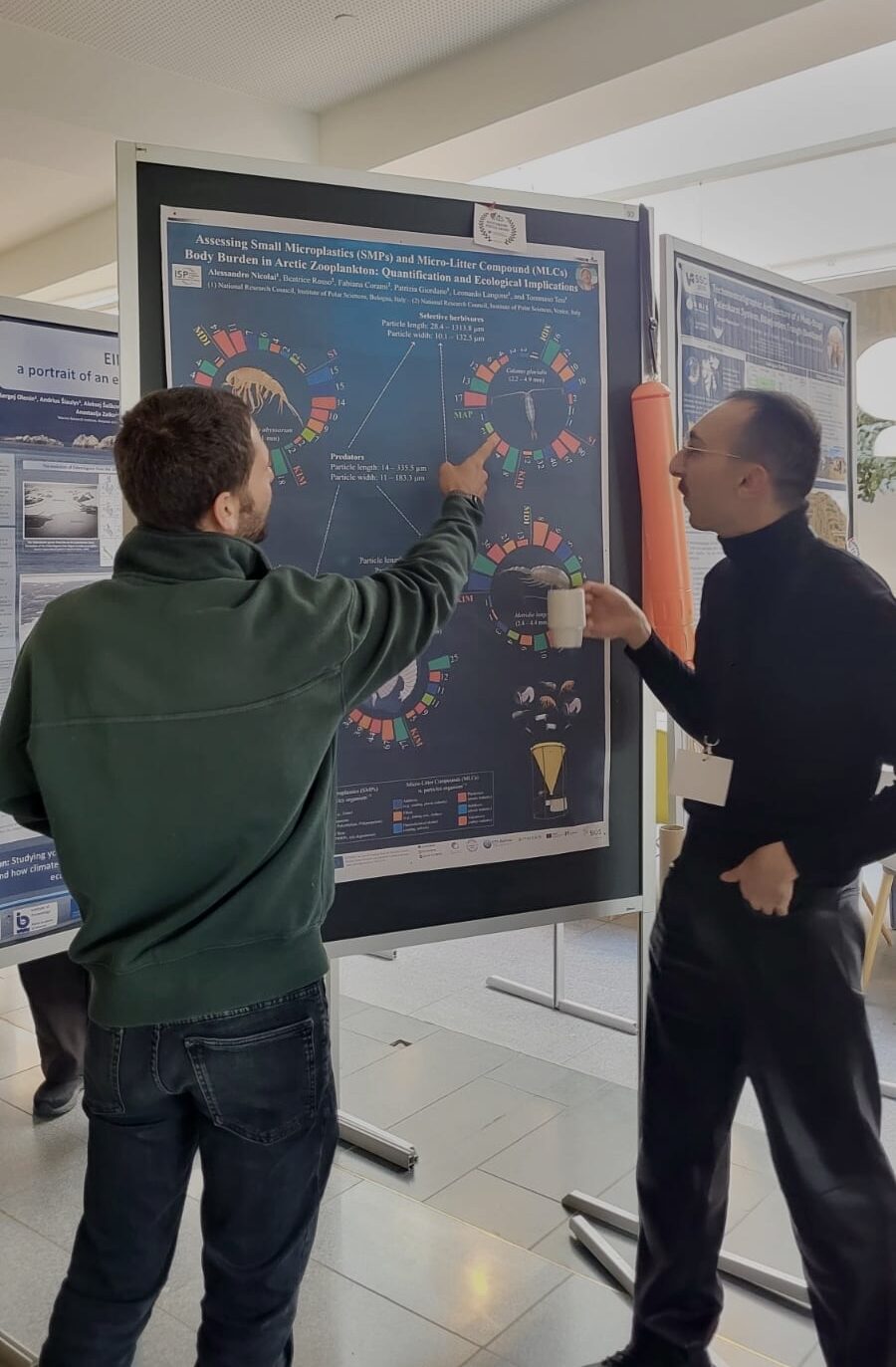
Alessandro Nicolai explains a scientific poster on microplastics in Arctic zooplankton to Dr. Francesco Paladini de Mendoza during a conference session.

Presenting research in action: Alessandro Nicolai discusses his poster with Dr. Francesco Paladini de Mendoza. Photo: Dr. Patrizia Giordano.

Reflections from Scientific Exchange

These findings represent a valuable contribution to the scientific community, shedding light on the distribution and bioaccumulation of scarcely detected compounds within the Arctic food webs.

Zooplankton emerged as a critical entry point for pollutants into the local food-web chain, confirming two main aspects:

  1. microplastics have inevitably reached even remote and seemingly pristine Arctic environments, and
  2. they can be transferred to higher trophic levels, including fish, marine mammals, and ultimately humans.

The presentation attracted significant interest from research groups in Poland, Norway and France, particularly regarding the methodologies adopted for chemical characterisation and quantitative analysis.

Participation in the Svalbard Science Conference 2025 was a unique opportunity to exchange ideas and perspectives with scientists working in polar research, engage with emerging research trends, and strengthen international collaborations.

I am sincerely grateful for this experience and I look forward to further contributing to and expanding knowledge on these crucial environmental issues.

Text by: Alessandro Nicolai, Italian Institute of Polar Sciences, CNR-ISP

Stay tuned for more

Stay tuned on ICEBERG by subscribing to our newsletter and following us on social media:

Subscribe to our newsletter and stay updated on the progress of the project.

Subscribe

Project Scientific Coordinator

Prof. Thora Herrmann
University of Oulu
thora.herrmann@oulu.fi

Co-coordinator, Project Manager

Dr Élise Lépy
University of Oulu
elise.lepy@oulu.fi

Communications

Marika Ahonen
Kaskas
marika.ahonen@kaskas.fi

Innovative Community Engagement for Building Effective Resilience and Arctic Ocean Pollution-control Governance in the Context of Climate Change

ICEBERG has received funding from the European Union's Horizon Europe Research and innovation funding programme under grant agreement No 101135130

Privacy Policy