November 3 2026

From the Arctic to the Antarctic: ICEBERG at Atlantic Plastics 2026 in Reykjavík

From 20 to 22 October, ICEBERG researchers Barbara Jóźwiak, Adam Nawrot and Victor Lion joined scientists, policymakers and practitioners at Harpa in Reykjavík. They attended the Third International Symposium on Marine Plastic Pollution from the Arctic to the Antarctic (Atlantic Plastics). In this blog they share key takeaways from the discussions and reflect on how the symposium’s themes connect with ICEBERG’s work.

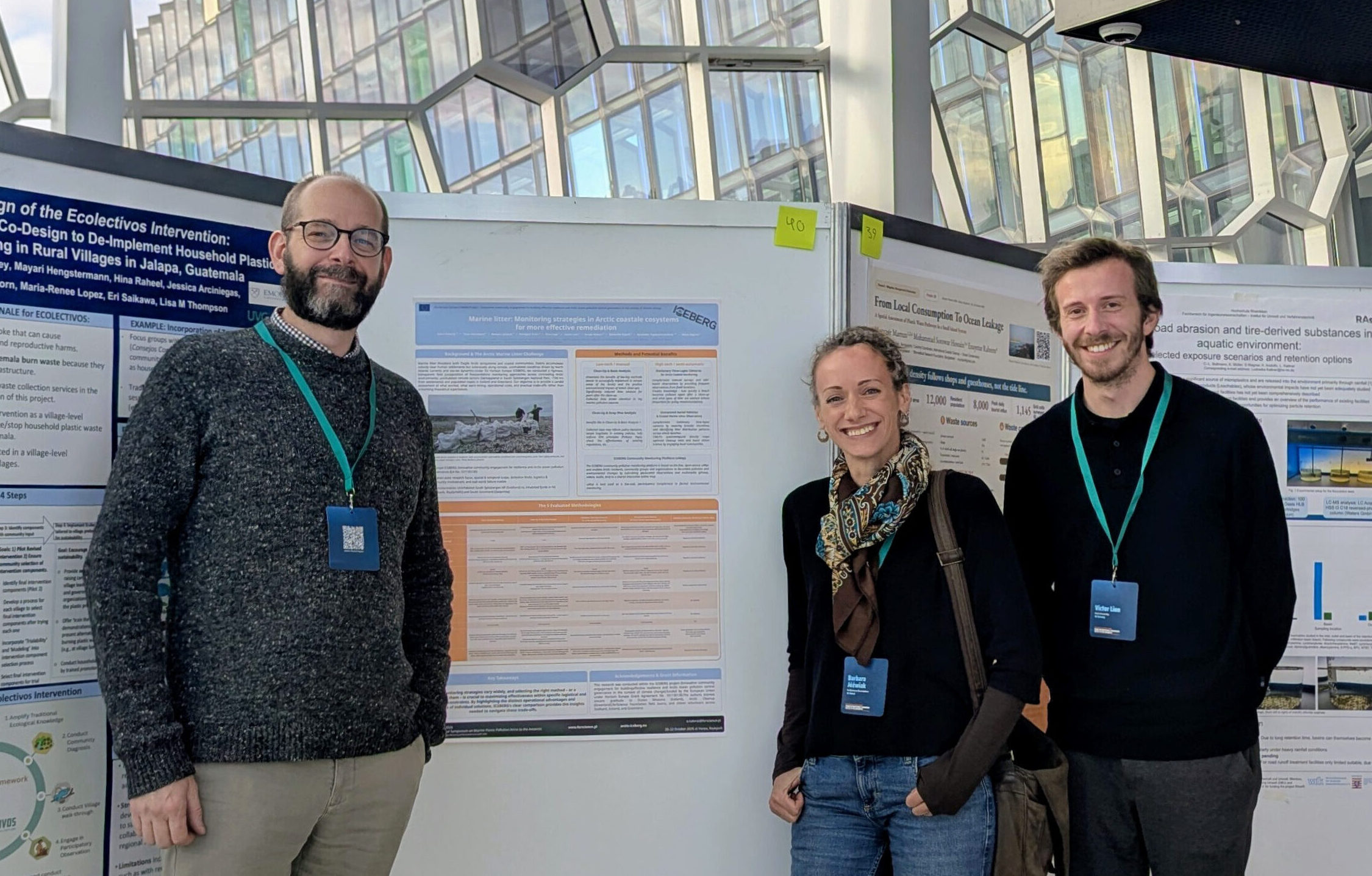
Three people standing and smiling in front of a poster at a science conference.

The team representing ICEBERG at the symposium. Photo credit: Jannike Falk-Andersson. Courtesy of the forScience Foundation.

The event was the third in a series hosted by the Government of Iceland. The first two editions, held online in 2021 and in Reykjavík in 2023, were known as Arctic Plastics and focused specifically on the Arctic and sub-Arctic regions. But because plastic pollution respects no regional borders, understanding the issue in any single region requires a much broader lens. This is why this year’s symposium widened its scope to the whole Atlantic, from the Arctic to the Antarctic, including connected seas such as the Mediterranean, the Caribbean and the Baltic.

While no single research project can boast a geographical scope quite as vast as Atlantic Plastics 2026, ICEBERG takes a similar approach. Although the primary focus in the project is the European Arctic, the researchers also look at pollution through a broad, interconnected lens, studying how plastics and other pollutants travel to the Arctic, where they accumulate and what their presence means for local ecosystems and the communities that depend on them.

Monitoring and Assessment of Plastic

One of the symposium’s central themes, Innovative Plastic Pollution Monitoring and Assessment Across Multi-Scales, was a natural fit for ICEBERG, drawing both a presentation and a poster from the team.

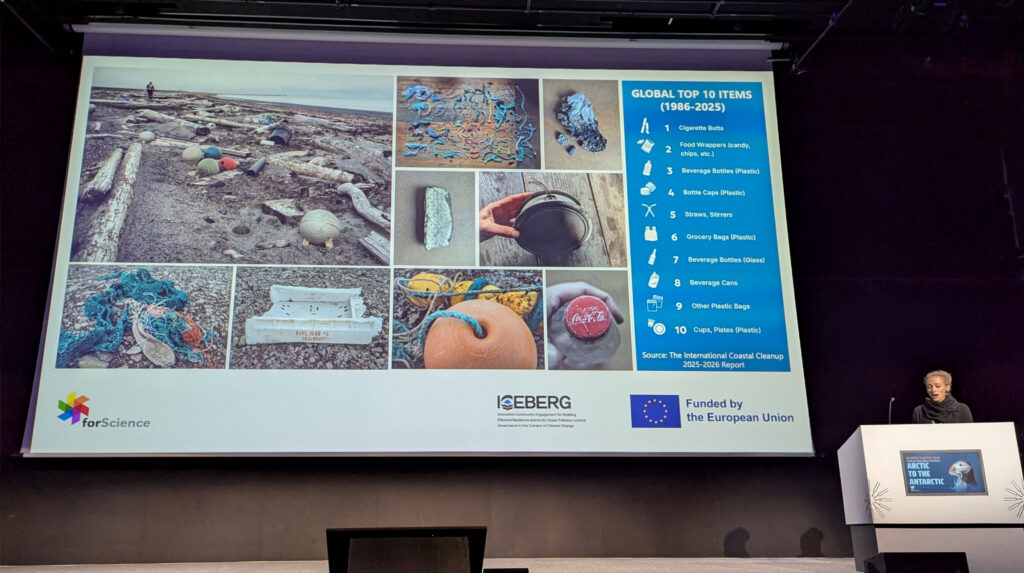
In the talk titled “From clean-up to science: An in-depth diagnostic approach to Arctic marine litter”, Barbara Jóźwiak from the forScience Foundation explored the possibilities and limitations of studying marine litter on remote Arctic shores, drawing directly on the meticulous analysis of over 8500 litter items collected by the forScience team in Sørkapp Land, Svalbard, during the 2024–2025 field seasons. A key takeaway was that the story we tell about marine litter depends heavily on the metric we adopt, with standard item counts yielding strikingly different results to mass-based measurements. And while field conditions mean that the mass data can only ever be an approximation, the difference between counting and weighing is so significant that the mass perspective should definitely be taken into account and explored further.

Zooming in from macroplastics to the nano-scale, Victor Lion from Kiel University presented their joint work with INRAE and the University of Oulu as a poster on “Unsupervised Morphometric Measurement of Nanoplastic Particles Using Electron Microscopy Images for Pollution Monitoring”. As nanoplastics are extremely small and difficult to characterise, the presented approach aims to automatically determine their size and shape. By reducing the need for human intervention, the method could enable faster, more consistent, and large-scale analysis of nanoplastic particles. This could help improve our understanding of how nanoplastics are distributed in the environment, how they are transported, and how they may interact with living organisms.

Picture of a presentation slide, showcasing different types of plastic waste.
Barbara Jóźwiak emphasised the discrepancy between global beach litter count statistics and the reality of the remote Arctic. Photo credit: Adam Nawrot, forScience Foundation

From Knowledge to Action: Mitigation and Policy

Innovations were not the only thematic area where ICEBERG researchers shared their insights during Atlantic Plastics 2026. Adam Nawrot, forScience Foundation, contributed to the mitigation, management and restoration theme with a poster entitled “Marine litter: Monitoring strategies in Arctic coastal ecosystems for more effective remediation”. In collaboration with ICEBERG partners, he compared five different approaches to marine beach litter assessment adopted by the forScience Foundation, Kiel University, SciDrones and the University of Oulu at different ICEBERG study sites, highlighting how different environments and research goals call for different methods.

Meanwhile, under the science–policy interface and capacity building theme, Victor Lion also presented another poster on “Integrating Lab and Field Approaches with Machine Learning and Citizen Science for Marine Litter Monitoring in Data-Sparse Arctic Regions”, representing joint work of Kiel University, SciDrones, and University of Oulu. By combining time-lapse cameras, drones, laboratory-based simulations, and machine learning, it aims to improve the detection and monitoring of beach litter across different locations and over time. Through the training of citizen scientists and the involvement of local and Indigenous communities, the approach further aims to support reliable, long-term marine beach litter monitoring in remote Arctic regions.

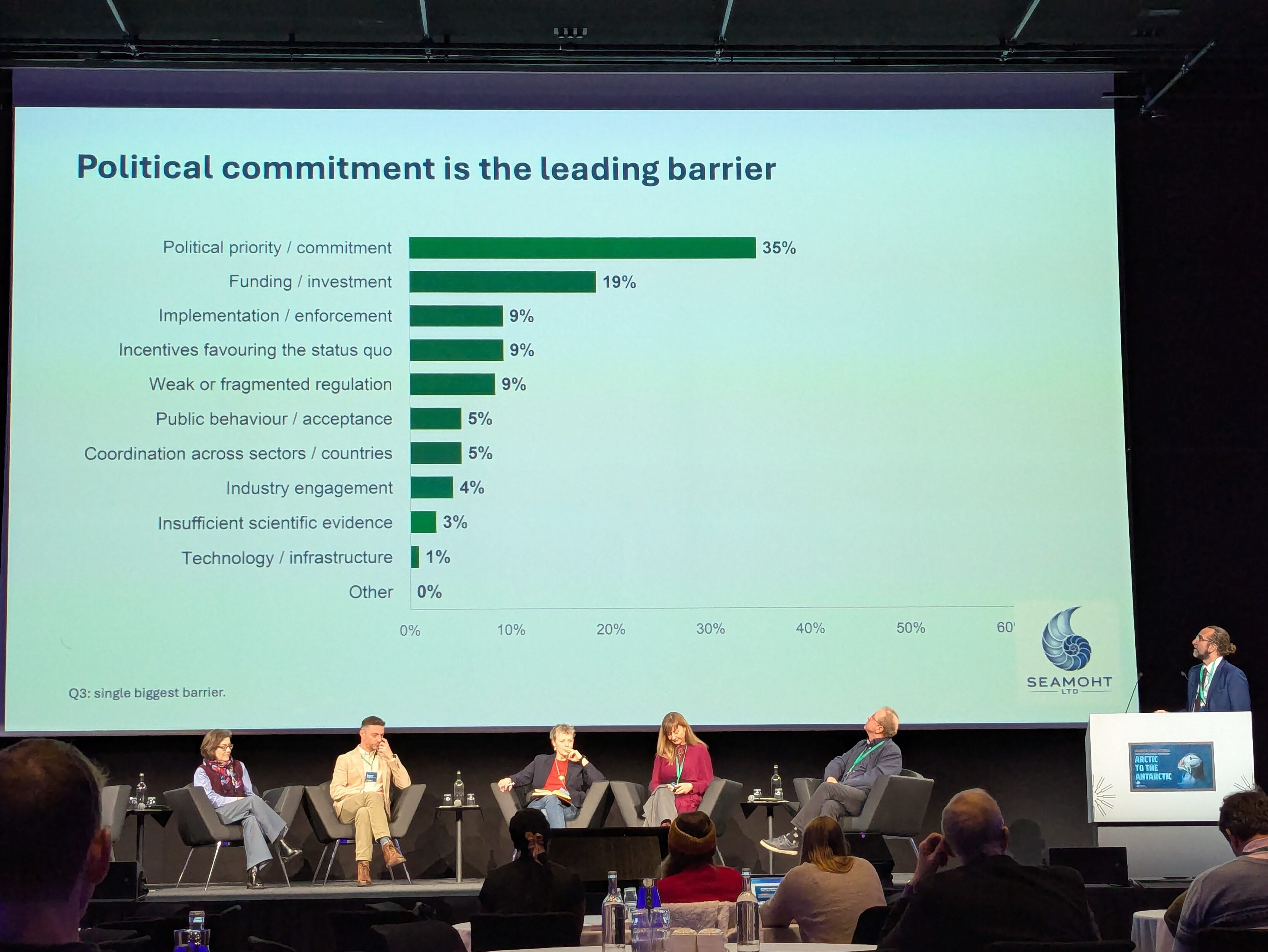
A picture of a panel of speakers on stage, a presentation slide behind them stating "political commitment is the leading barrier".

Political commitment remains the leading barrier to systemic change. Photo credit: Barbara Jóźwiak, forScience Foundation.

Personal reflections

Next, Victor Lion from Kiel Univerity shares his personal thoughts about the conference.

What impressed me most at the conference was the diversity of people from around the world, all coming together with a shared commitment to tackling plastic pollution. A particular highlight for me was the panel discussion on “Indigenous Approaches for Actionable Solutions to Plastics Pollution” on the final day, which was especially relevant to our work within ICEBERG, highlighting that research with Indigenous communities must begin with relationships and shared decision-making, with Indigenous knowledge treated as equal to Western science.

The strong sense of connection and collaboration among the participants also extended beyond the conference itself, with a beach clean-up organized by Worldwide Friends (Veraldarvinir), Ocean Conservancy, and Hold Norge Rent south of Reykjavík directly following the conference, where around 60 participants (most of whom had attended the conference) came together to take action beyond the conference venue.

Barbara Jóźwiak from the forScience Foundation highlights the identified challenges:

Atlantic Plastics 2026 was a fantastic opportunity to reconnect with colleagues and meet researchers whose work we had followed from afar, including fellow Arctic clean-up actors. The sheer variety of presentations and posters afforded a range of distinct perspectives, while conversations struck up during coffee breaks left plenty to look forward to in terms of future collaborations. That said, the symposium also served as a reality check.

Many of the core issues identified in 2023 – such as method harmonisation, cross-sectoral collaboration and the need to curb plastic production – remain largely unresolved, with a lack of political commitment standing out as the primary barrier to systemic change. Gaining the upper hand in the struggle against plastic pollution will also require bringing the chemical industry, plastic producers and product designers to the table, all of whom have so far been absent from the discussions. I’m hoping the organisers manage to close this gap for the next edition of the event.

Text: Barbara Jóźwiak, Victor Lion and Adam Nawrot

Stay tuned for more

To stay tuned about ICEBERG, follow us on social media and subscribe to our newsletter to get the updates to your own email.

Get to know more ICEBERG people:

Find ICEBERG on:

Subscribe to our newsletter and stay updated on the progress of the project.

Subscribe

Project Scientific Coordinator

Prof. Thora Herrmann
University of Oulu
thora.herrmann@oulu.fi

Co-coordinator, Project Manager

Dr Élise Lépy
University of Oulu
elise.lepy@oulu.fi

Communications

Marika Ahonen
Kaskas
marika.ahonen@kaskas.fi

Innovative Community Engagement for Building Effective Resilience and Arctic Ocean Pollution-control Governance in the Context of Climate Change

ICEBERG has received funding from the European Union's Horizon Europe Research and innovation funding programme under grant agreement No 101135130

Privacy Policy Manage cookies